

The rapid growth of AI-driven workloads—ranging from generative models to real-time analytics—is significantly increasing the demand for computing power. This surge is placing substantial pressure on data center infrastructure, particularly in managing heat and energy consumption.
To meet performance demands, higher compute density is being deployed through advanced processors and accelerator clusters within existing facilities. However, this increase in density intensifies thermal loads, making heat a critical constraint that conventional air-based cooling systems struggle to manage effectively.
Data Movement: A Hidden Driver of Heat
Heat generation is no longer limited to computation alone. Data movement across compute, memory, and storage systems has become a major contributor to overall thermal load.
In many cases, the energy required to transfer data can exceed the energy used for processing it. As data volumes and model complexity grow, the thermal and energy impact of data movement increases significantly. This makes interconnect efficiency a key factor in overall system performance.
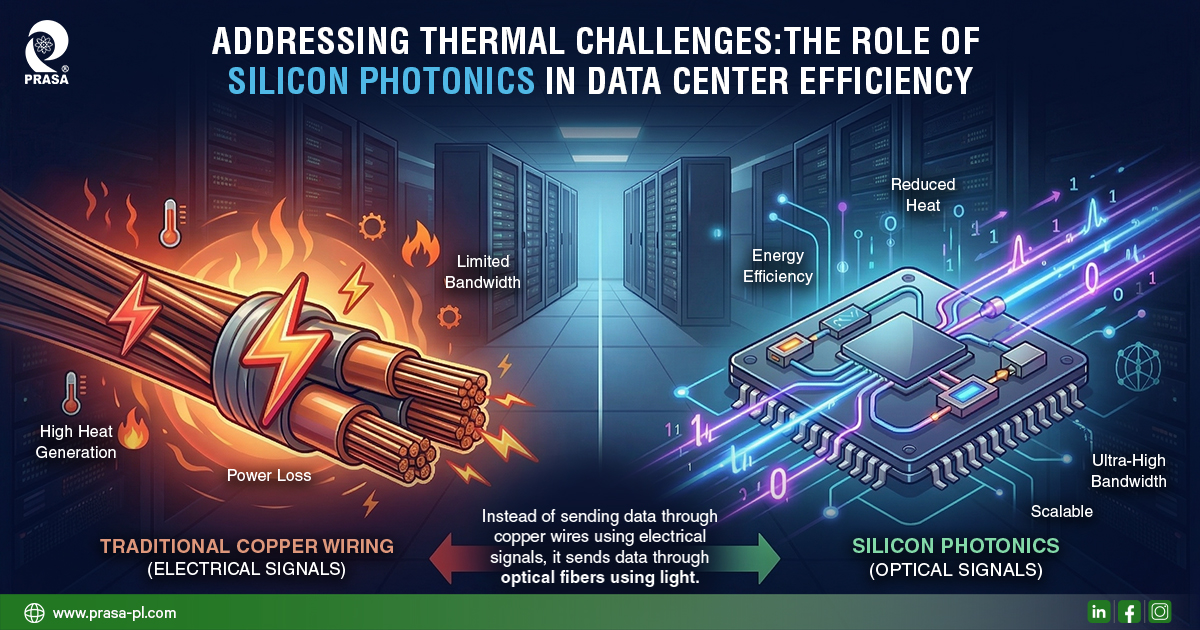
Traditional electrical interconnects, particularly those based on copper, introduce resistive losses that generate additional heat. As performance and density requirements increase, these limitations become more pronounced, driving the need for more efficient alternatives.
The Shift Toward Optical Interconnects
Optical interconnect technologies are emerging as a more efficient solution for high-performance environments. By transmitting data using light instead of electrical signals, these systems reduce energy consumption per bit and significantly lower heat generation.
This approach helps minimize the burden on cooling systems while improving overall efficiency, making it particularly suitable for high-density and thermally constrained environments.
Advancing Efficiency with Silicon Photonics
Silicon photonics enables data transmission through optical pathways, reducing power consumption and thermal output compared to traditional methods. By integrating optical components directly within the system architecture, it eliminates several inefficiencies associated with external components and signal conversion.
Modern photonic integration techniques are enabling higher data throughput while operating at lower power levels and elevated temperatures. This results in improved system efficiency, reduced thermal stress, and simplified infrastructure requirements.
Enhanced coupling efficiencies and lower voltage requirements further contribute to reduced electrical demand, enabling stronger performance with lower energy input.
Scalable Architecture for Future Demands
The adoption of photonic technologies supports a modular and scalable system architecture capable of handling increasing bandwidth requirements. This allows infrastructure to evolve alongside growing computational demands without significantly increasing thermal or energy constraints.
By reducing heat generation at the source, these systems enable higher compute density without requiring major upgrades to cooling infrastructure.
Enabling the Next Generation of Data Centers
As computing environments continue to evolve, managing heat efficiently has become as important as improving processing speed. Traditional approaches to cooling and performance optimization are reaching their limits, making it essential to rethink how data moves within systems.
By addressing the thermal impact of data movement, silicon photonics offers a pathway to more efficient, scalable, and sustainable infrastructure. The future of high-performance computing will depend not only on speed, but also on intelligent design that balances performance with energy and thermal efficiency.
Why It Matters in Data Centers
1. Faster Data Transfer
- Supports extremely high bandwidth (100G, 400G, 800G and beyond)
- Ideal for AI workloads and high-performance computing
2. Lower Power Consumption
- Uses less energy per bit compared to electrical transmission
- Reduces overall power usage in large-scale facilities
3. Reduced Heat Generation
- Minimal resistive losses (unlike copper cables)
- Helps reduce cooling requirements
4. Higher Density
- Enables more compute power in the same space
- Supports dense GPU/AI clusters
5. Longer Distance Without Loss
- Optical signals travel farther without degradation
- Better for large data center campuses
As data center demands continue to evolve, adopting smarter and more efficient technologies is essential. Silicon photonics enables enhanced performance, reduced energy consumption, and improved thermal efficiency. To explore how these innovations can support your infrastructure goals, connect with PRASA at +918806660084 or email us at marketing@prasa-pl.com.
