

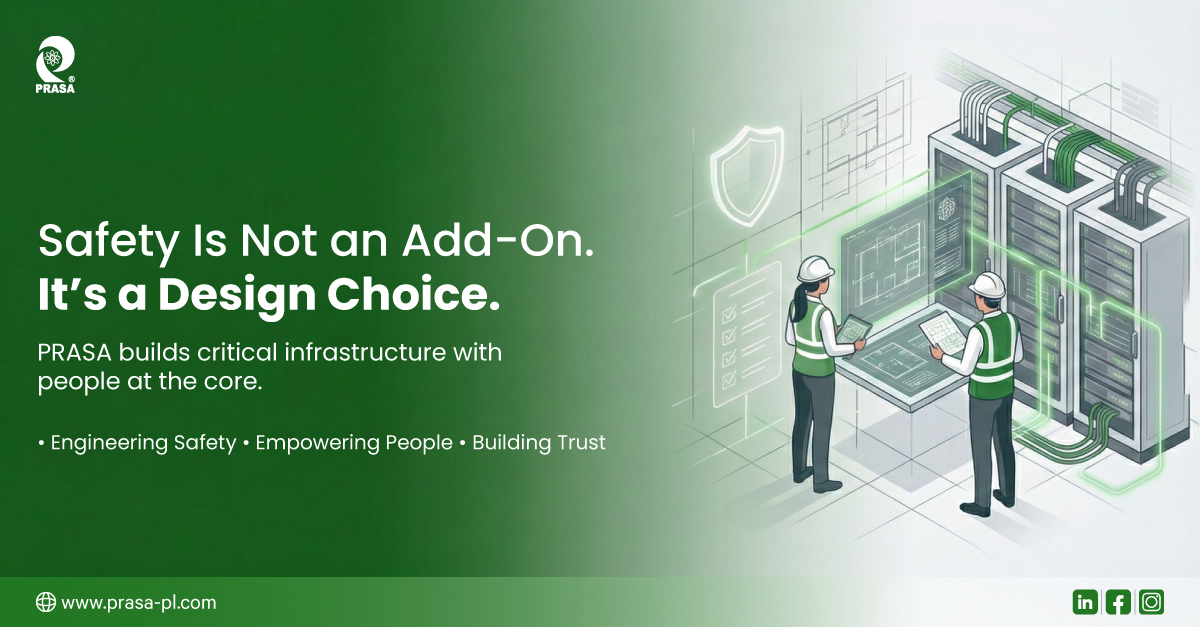
When you work in critical infrastructure, one truth becomes clear very quickly: safety is not something you add later—it is a decision you make on day one.
Infrastructure today does more than support businesses. It underpins economies, public services, and national digital resilience. In such environments, availability, reliability, and scalability are essential—but they are meaningless if the people who build and operate these systems are not protected, supported, and empowered.
At PRASA, safety has never been viewed as a regulatory obligation or a box to be checked. It is a fundamental value that influences how we design facilities, execute projects, operate mission-critical environments, and make leadership decisions—especially when no one is watching.
Safety as a Foundational Culture
When PRASA began its journey, the digital infrastructure ecosystem was still developing. Operational consistency varied, tolerance for downtime was common, and best-in-class safety benchmarks were not always the norm.
From the very beginning, we chose a different path.
We believed that global-grade infrastructure cannot exist without uncompromising safety standards. This belief shaped every aspect of our operations—engineering design, partner selection, site protocols, and leadership accountability. Safety was never isolated within a department; it became an integral part of how the organization functioned.
Over time, this mindset evolved into a culture where individuals are not only trained to comply with procedures but are encouraged to take ownership—of their own safety, their colleagues’ well-being, and the environments they operate in.
Making Safety a Shared Responsibility
As PRASA expanded, our approach to Environment, Health, Safety, and Well-Being (EHS&W) matured well beyond statutory compliance. We built a structured, globally aligned safety management framework supported by clear operating procedures, defined risk controls, emergency preparedness plans, and regular internal and external audits.
But systems alone do not create a safe workplace—people do.
We made a conscious decision to foster an environment where employees, contractors, and partners are equally responsible and equally empowered when it comes to safety.
This culture is reflected in everyday actions:
- Unsafe practices can be challenged openly, irrespective of designation or hierarchy
- Work is paused immediately if conditions are deemed unsafe
- Choosing safety over speed is always supported
- Any form of safety negligence is addressed with zero tolerance
This clarity builds trust and accountability, ensuring safety is not enforced from the top down, but owned collectively by everyone on site.
Engineering with Safety at the Core
Data centers and mission-critical facilities are inherently complex environments—characterized by high-voltage electrical systems, dense equipment layouts, and continuous operations.
At PRASA, safety is engineered into the infrastructure itself. From advanced fire detection and suppression technologies to rigorous electrical safety protocols, certified technical teams, and routine preventive audits, every element is designed with risk mitigation in mind.
Emergency response drills, readiness assessments, and scenario-based testing are conducted regularly to ensure preparedness is not theoretical, but practical.
- Preparedness is not an annual activity—it is a continuous discipline.
- Caring for People Beyond the Workplace
- True safety goes beyond physical risk management.
PRASA places equal emphasis on employee well-being—physical, mental, and emotional—as a cornerstone of sustainable performance. Regular health screenings, wellness initiatives, stress-management programs, mindfulness sessions, and thoughtfully designed recreation spaces help foster a healthier and more resilient workforce.
Recognition initiatives, engagement programs, and long-service acknowledgements further reinforce a culture where people feel valued, respected, and supported.
Because when people feel cared for, they make safer choices.
Where Safety and Sustainability Converge
At PRASA, safety and sustainability are deeply interconnected.
Our EHS philosophy aligns closely with our environmental responsibility—from energy-efficient infrastructure and renewable energy adoption to responsible waste management, elimination of single-use plastics, and disciplined chemical handling practices.
Protecting people and protecting the environment are not parallel efforts—they are part of the same commitment to long-term resilience and responsible infrastructure development.
Conclusion
Safety at PRASA is not an initiative, a program, or a policy.
It is a culture, shaped by consistent decisions, disciplined execution, and a genuine commitment to people.
Because the strongest infrastructure is built not just on technology—but on trust, responsibility, and care.
