

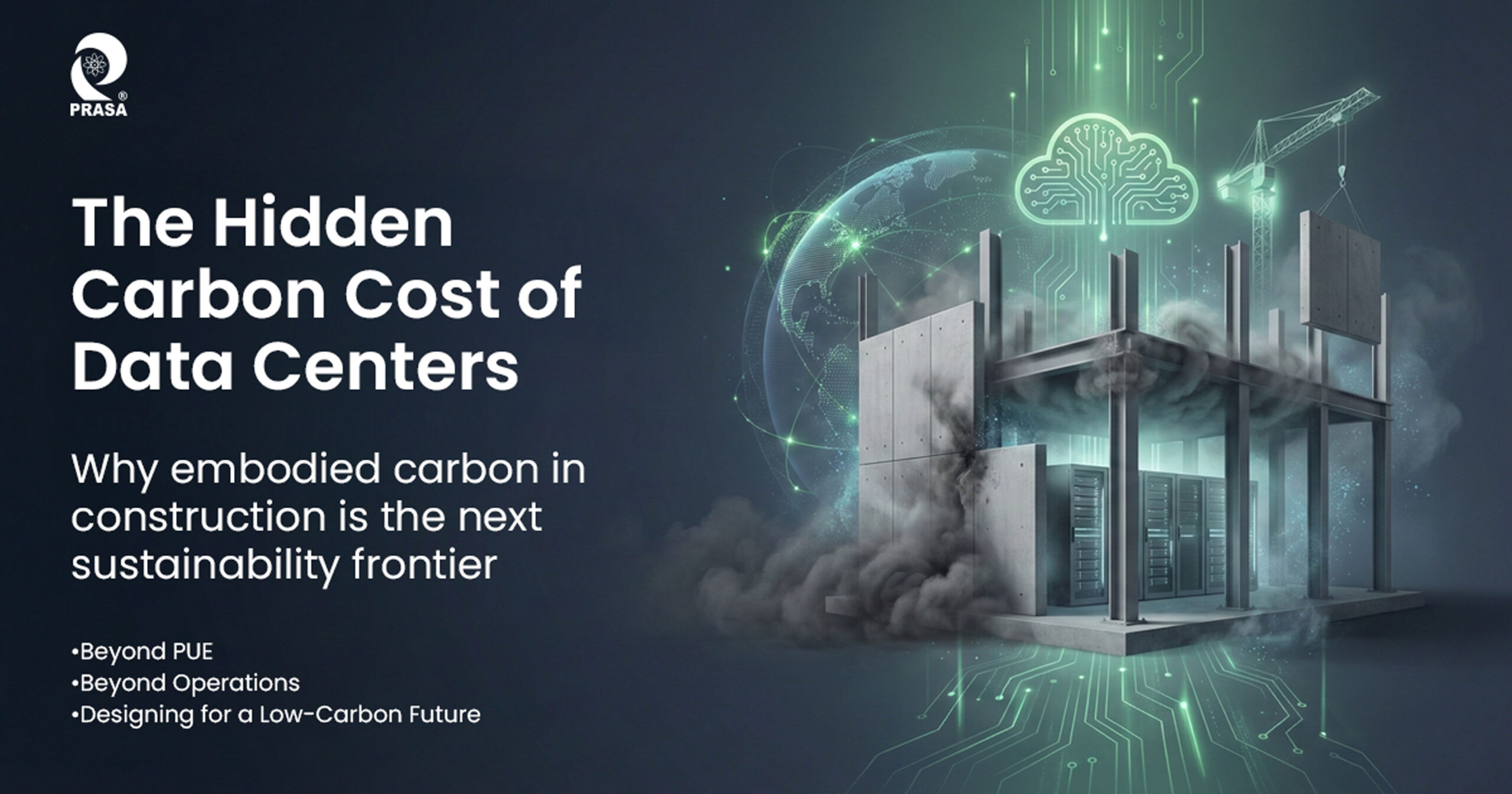
The global surge in data center construction—driven by AI, cloud adoption, and digital transformation—has reshaped how we think about energy efficiency and sustainability. Metrics like PUE, renewable energy sourcing, and grid optimization now sit at the heart of every serious data center conversation.
But a critical emissions source is still flying under the radar: embodied carbon in construction materials—especially concrete.
Recent industry analysis highlights a sobering reality. Long before the first server is powered on, massive volumes of carbon-intensive concrete are poured, quietly locking in emissions that will remain embedded for decades. As data center footprints scale rapidly, this construction-phase impact is becoming a first-order climate challenge, not a footnote.
Why Embodied Carbon Matters Now
Concrete is foundational to data center design—structural slabs, foundations, walls, and hardened infrastructure. While operational emissions can be optimized over time, embodied carbon is irreversible once construction is complete.
With hyperscale and colocation projects accelerating globally, ignoring embodied carbon risks undermining even the most efficient operational sustainability strategies.
Shifting the Sustainability Lens: From Operations to Construction
To build truly future-ready, low-carbon data centers, the industry must elevate embodied carbon to a core design KPI, alongside cost, schedule, resilience, and uptime.
Key strategies gaining traction include:
-
Low-carbon concrete mixes
Leveraging supplementary cementitious materials (SCMs) to reduce reliance on traditional Portland cement. -
EPD-based procurement
Using Environmental Product Declarations to make carbon-transparent material choices. -
Life Cycle Assessment (LCA) at concept stage
Embedding carbon analysis early—before design decisions are locked in. -
Modular and repeatable designs
Minimizing overbuilding, construction waste, and rework through standardized layouts. -
Designing for retrofit and reuse
Enabling future densification without repeated structural pours.
The Competitive Advantage of Early Decarbonization
The next generation of “green data centers” will not be defined solely by efficient operations—but by how intelligently they are built.
Organizations that decarbonize both construction and operations will gain:
-
Stronger ESG credibility
-
Lower long-term environmental risk
-
Greater regulatory readiness
-
A clear edge in customer and investor confidence
Sustainability leadership is no longer about what happens after commissioning—it begins at the drawing board.
Looking Ahead
As demand for digital infrastructure continues to surge, the industry faces a pivotal question:
Are we designing data centers only for performance—or for permanence with responsibility?
The answer will define the environmental legacy of the digital age.
At PRASA, we partner with data center owners and stakeholders to embed sustainability into design and construction—where decisions have the greatest long-term impact.
If you’re planning a new facility or upgrading an existing one and want to address embodied carbon through smarter materials, modular design, and future-ready infrastructure, connect with us at marketing@prasa-pl.com or call +91-8806660084 to explore how we can support your sustainability goals.
