

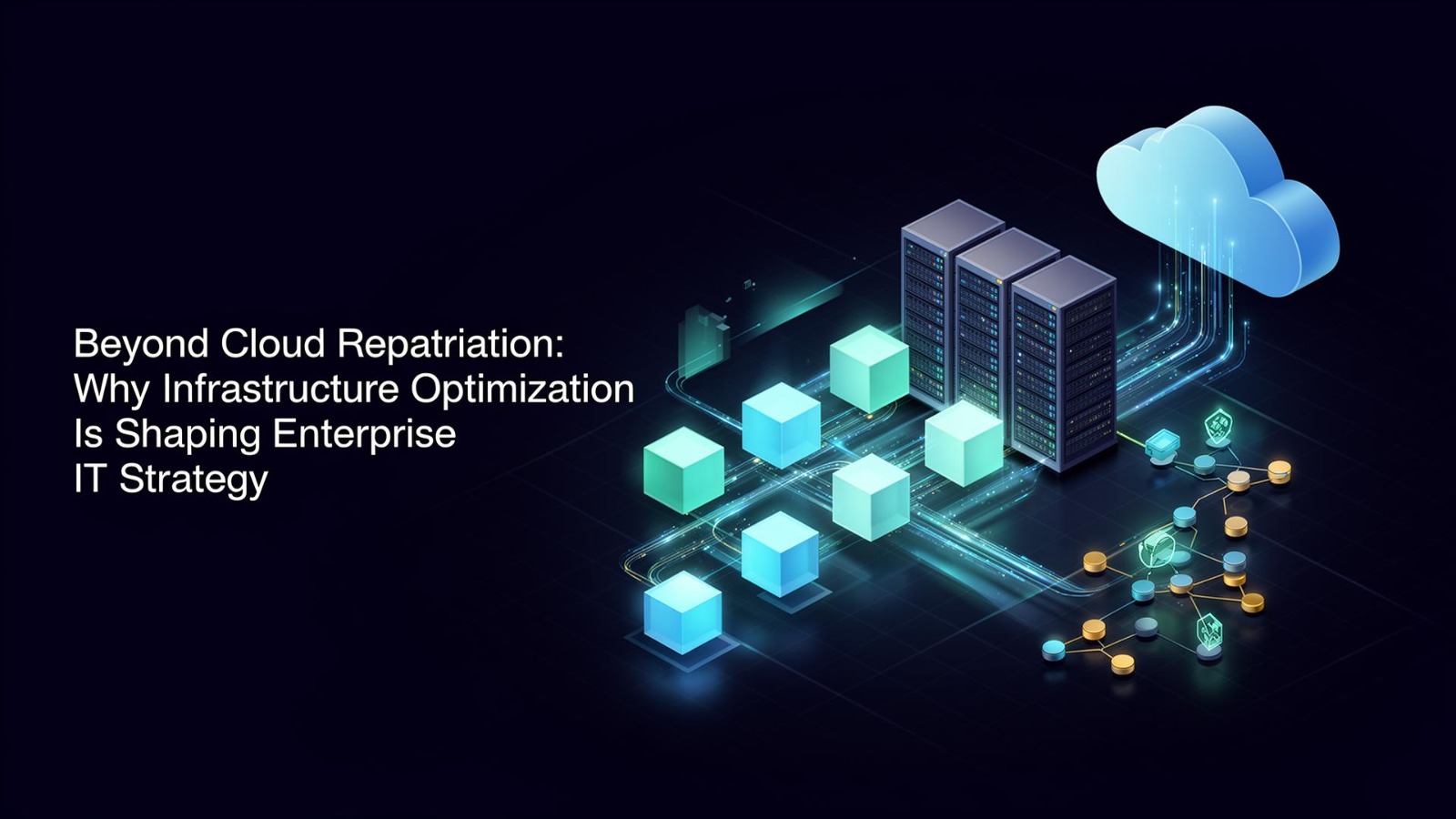
Beyond Cloud Repatriation
Why Infrastructure Optimization Is Shaping Enterprise IT Strategy
Most discussions around cloud repatriation focus on whether organizations are moving workloads out of public cloud environments.
That framing misses the larger shift underway.
The real transformation is not cloud repatriation. It is infrastructure optimization.
From Cloud-First to Workload-First
For years, enterprises approached cloud adoption with a simple objective: move applications to the cloud and gain agility. It was a binary decision on-premises or cloud driven more by technology trends than by rigorous analysis of workload requirements.
As digital ecosystems matured, organizations began to understand that infrastructure decisions are rarely one-size-fits-all. The economics of sustained cloud usage, the emergence of AI-driven compute demands, and the complexity of multi-region compliance have all contributed to a more sophisticated view of infrastructure strategy.
Today, every workload carries its own requirements for performance, latency, compliance, security, scalability, and cost predictability. The challenge is no longer deciding between cloud and on-premises infrastructure. The challenge is determining where a workload can operate most efficiently throughout its lifecycle.
Workload-Centric Infrastructure Decisions
Different workloads demand different environments. Consider the following scenarios:
- Customer-facing web applications: These often benefit from the elasticity and global reach of public cloud platforms, where autoscaling handles traffic spikes without capital expenditure.
- AI and machine learning training environments: These frequently require dedicated high-density infrastructure with specialized GPU clusters, direct liquid cooling, and predictable power—requirements that may be more efficiently met in colocation facilities or private data centers.
- Compliance-sensitive databases: Financial records, healthcare data, and sovereign information may be better suited to private environments with tighter governance controls, air-gapped networks, and auditable physical security.
- Edge and IoT processing: Low-latency requirements for manufacturing, autonomous systems, or real-time analytics often push compute closer to the data source—well beyond centralized cloud regions.
The New Infrastructure Philosophy
This evolution is driving a fundamental shift in how organizations think about infrastructure.
Rather than designing around technology preferences, organizations are designing around workload requirements.
As a result, modern digital infrastructure is becoming increasingly distributed. Public cloud, colocation facilities, edge locations, private environments, and dedicated infrastructure are no longer competing alternatives. They are operating as interconnected components of a larger ecosystem—each playing a role optimized to the workloads it serves.
The success of this model depends on three critical capabilities: visibility across environments, interoperability between platforms, and operational consistency regardless of location. The question is no longer where a workload lives. The question is how well the overall infrastructure portfolio supports business outcomes.
Reframing the Strategic Question
In this environment, the most strategic question is not:
“Should we move to the cloud?”
Nor is it:
“Should we leave the cloud?”
Instead, organizations should ask:
“What infrastructure model delivers the best outcome for this workload?”
The Future of Enterprise Infrastructure
The future belongs neither to cloud-only nor on-premises-only architectures.
It belongs to organizations that can align infrastructure decisions with business outcomes—that can match the right environment to the right workload, optimize for total cost of ownership, and maintain the agility to adapt as requirements change.
This demands a new class of infrastructure partner: one that understands not only colocation, cloud connectivity, and private facilities, but also how these elements integrate into a coherent, workload-optimized strategy.
Infrastructure optimization is not a destination. It is a continuous discipline—and the organizations that master it will define the next era of enterprise IT.
About This Perspective
PRASA, a strategic infrastructure advisor capable of guiding organizations through workload-optimized, multi-environment architecture decisions spanning data center colocation, hybrid cloud, AI infrastructure, and mission-critical facilities.
