

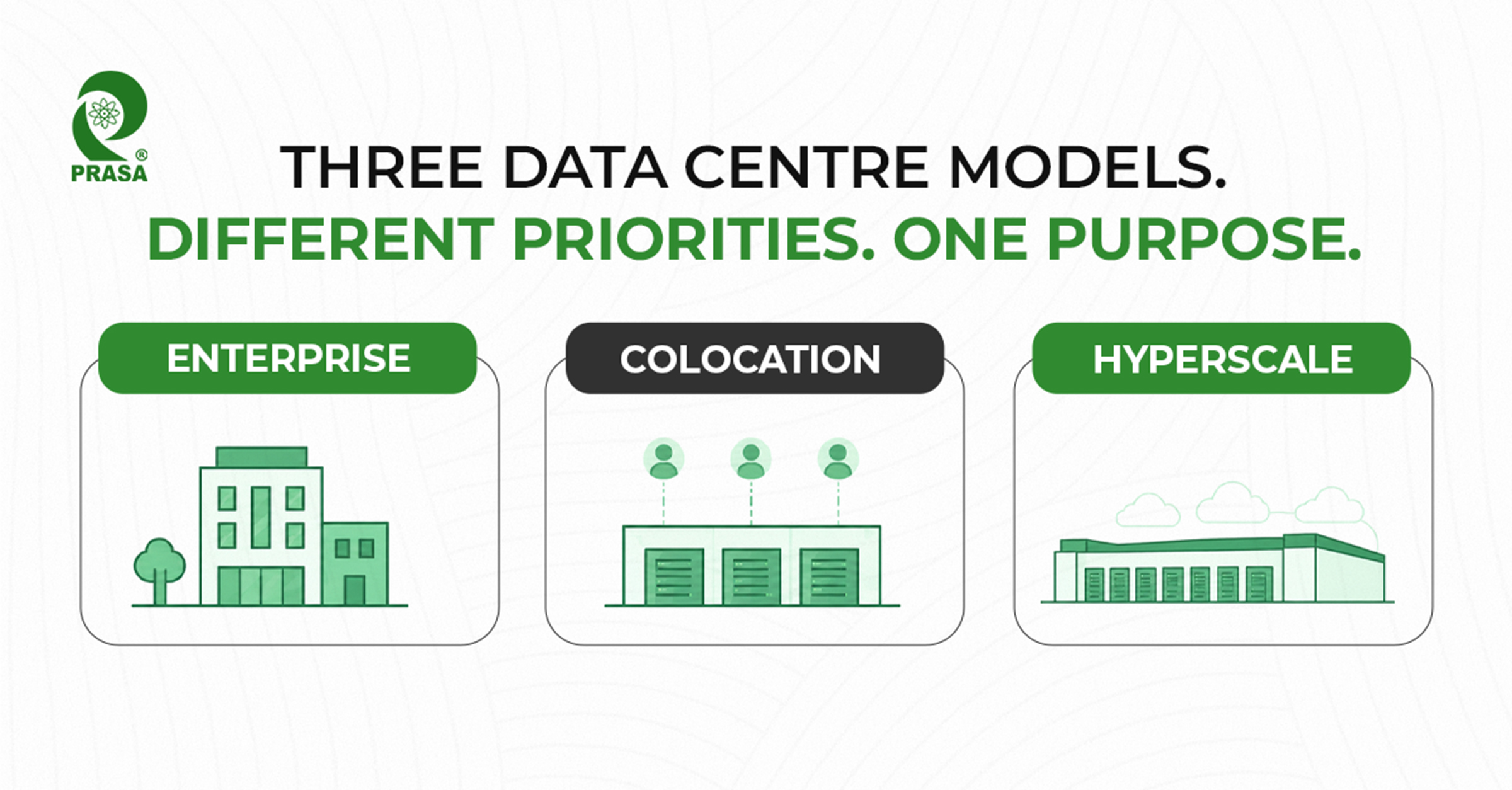
Data centres are often described through three broad models: Enterprise, Colocation and Hyperscale.
The definitions are straightforward, but the infrastructure requirements behind each model are very different.
- Enterprise data centres are primarily built around the requirements of a single organisation.
- Colocation data centres provide shared facility infrastructure to multiple customers, who typically deploy and manage their own IT equipment.
- Hyperscale data centres are designed for very large-scale computing environments, with a strong emphasis on standardisation, automation and rapid capacity expansion.
In practice, these categories can overlap. What distinguishes them is not simply ownership or size, but how capacity is designed, operated and scaled.
- Enterprise: Infrastructure built around the business
Enterprise environments are closely tied to the organisation’s applications, workloads and operational priorities.
The infrastructure therefore needs to be aligned with actual business requirements—from power availability and redundancy to cooling, monitoring and physical security.
The emphasis is on reliability, control and flexibility. Infrastructure should support today’s workloads while allowing the facility to evolve without unnecessary complexity.
- Colocation: Infrastructure built for flexibility
Colocation introduces a different challenge: one facility needs to support multiple customers, workloads and rack configurations.
Power distribution, cooling and physical infrastructure need to accommodate changing requirements while maintaining predictable performance and availability.
This makes modularity and scalability particularly important. Infrastructure that can be configured, expanded and deployed in repeatable formats enables operators to respond more efficiently to changing demand.
- Hyperscale: Infrastructure built to scale
At hyperscale, the challenge is no longer simply adding capacity. It is doing so consistently, efficiently and repeatedly across large deployments.
Standardised designs, automation and repeatable infrastructure become increasingly important because even a small improvement in design or efficiency can have a significant impact when replicated at scale.
The growth of AI is adding another dimension. Higher-density computing is increasing demands on power distribution and thermal management, making high-density cooling and liquid cooling increasingly relevant for specific workloads and applications.
PRASA perspective: The infrastructure strategy starts with the workload
At PRASA, we see the data centre differently, not as a collection of individual systems, but as one integrated engineering ecosystem.
The right infrastructure strategy starts with understanding the workload, density, criticality and growth trajectory of the facility. From there, power, cooling, physical infrastructure, IBMS and modularisation need to be engineered to work together.
This matters because the infrastructure decisions made at the beginning of a project influence reliability, efficiency, scalability and deployment speed throughout its lifecycle.
For a conventional enterprise environment, that may mean designing for flexibility and operational control.
For colocation, it may mean creating modular infrastructure that can accommodate diverse and changing customer requirements.
For hyperscale and AI-ready environments, it increasingly means designing for higher densities, repeatable deployment and future thermal and power requirements.
The engineering approach has to change with the workload.
From project execution to repeatable infrastructure
The industry is also moving towards greater prefabrication and modularisation.
For PRASA, this represents more than a construction methodology. It is an opportunity to bring engineering, manufacturing, testing and deployment closer together.
By shifting more work into controlled environments, infrastructure can become more repeatable, quality can be more consistently managed, and site execution can become more predictable.
That becomes increasingly valuable as data-centre projects move towards faster deployment and larger-scale replication.
Designing beyond today’s requirements
Enterprise, colocation and hyperscale may represent different operating models, but they face a common challenge: the workload is changing faster than traditional infrastructure assumptions.
- Higher densities.
- AI-driven compute.
- Faster capacity expansion.
- Greater efficiency expectations.
- More complex operational requirements.
The question is therefore no longer simply:
What type of data centre are we building?
It is:
What infrastructure architecture will allow that data centre to perform reliably today, scale efficiently tomorrow and adapt to the workload after that?
That is where PRASA’s engineering perspective comes in.
We don’t just build infrastructure for today’s data centre. We engineer it with the next requirement in mind.
The model may be different. The engineering has to be smarter.
