

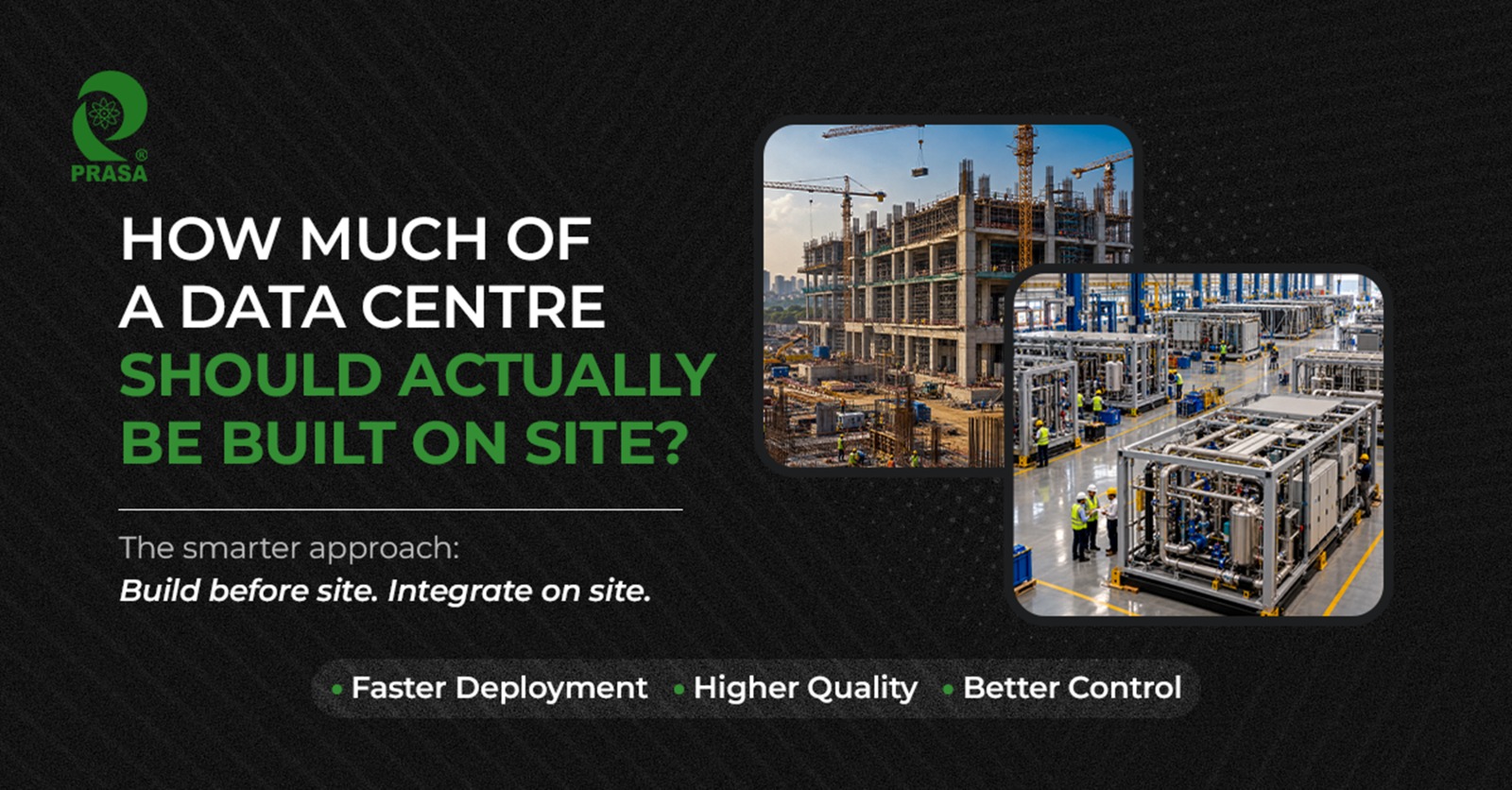
How Much of a Data Centre Should Actually be Built on Site
For years, “construction” has meant bringing materials, equipment, people and processes to the site and putting everything together there, but data centre projects are becoming more complex, denser and more time-sensitive. So, does every part of the infrastructure still need to be built and integrated at the final site?
Perhaps the better question is:
What if more of the data centre could be engineered, assembled and validated before it reached the site?
Think beyond a single equipment package.
- Power infrastructure.
- Cooling systems.
- Racks and containment.
- Electrical distribution.
- Monitoring and controls.
- Fire and safety systems.
- Skids, modules and integrated assemblies.
The shift is in where the work happens.
Built in a controlled environment.
Major assemblies can be manufactured and integrated under controlled factory conditions, with repeatable processes, defined quality checks and better coordination between disciplines.
Tested before dispatch.
Electrical, mechanical, controls and other integrated systems can be checked and validated before they reach the project site — moving more testing and troubleshooting upstream.
Transported to site.
Instead of moving hundreds of individual components and managing every assembly activity on site, larger engineered modules can arrive substantially complete and ready for installation.
Installed, connected and commissioned.
Site activity becomes focused on placement, interconnection, integration and commissioning rather than building every system from the ground up.
This is where the difference between conventional, prefabricated and containerised data centre approaches becomes important.
A conventional build keeps more of the assembly and integration activity at site.
A prefabricated data centre shifts selected infrastructure and assemblies into a controlled manufacturing environment while retaining flexibility in how the overall facility is configured.
A containerised data centre takes that modularity further, packaging critical infrastructure within a transportable enclosure designed for deployment with significantly less site construction, and then there is the changing cooling equation.
As AI and high-density workloads push rack power densities higher, liquid cooling is becoming an increasingly important part of the infrastructure conversation. Cooling distribution, CDUs, piping and associated systems can be engineered and integrated into modular solutions rather than being treated as a completely separate site activity.
For PRASA, this convergence of prefabrication, containerisation, power, cooling, controls and liquid cooling is less about replacing conventional construction and more about deciding what should happen where because the objective isn’t simply to build faster.
It is to move the right work to the right environment where it can be engineered, manufactured, tested and validated with greater control.
The site then becomes less of a construction ground and more of an integration point.
So, the conversation changes from:
“How fast can we build?”
to:
“How much can we engineer, manufacture and validate before we arrive?”
That may be one of the more important questions shaping the next generation of data centre infrastructure.
Build less on site. Build more before site.
