

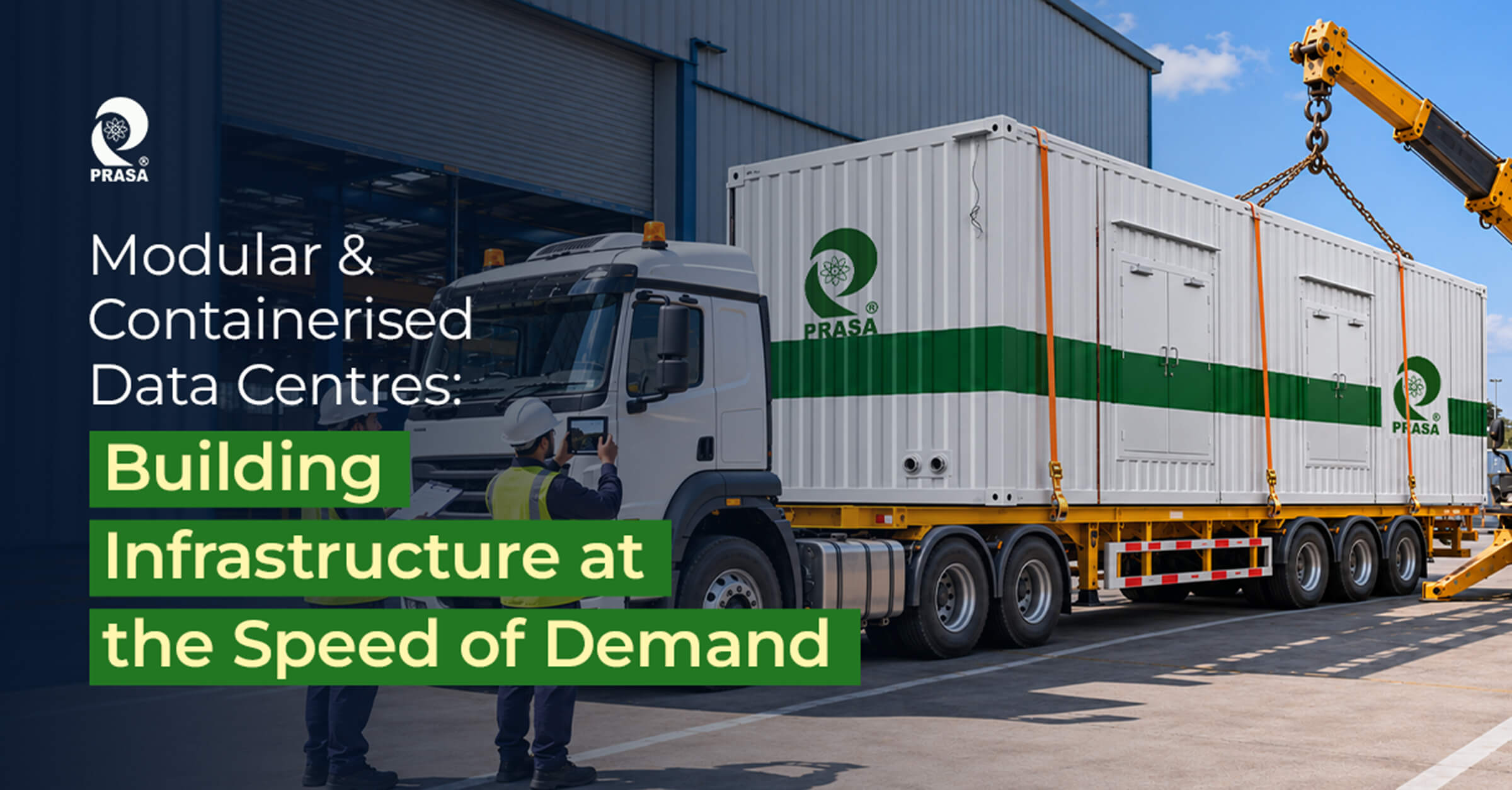
Modular & Containerised Data Centres: Building Infrastructure at the Speed of Demand
As demand for computing capacity grows, traditional data centre construction can struggle to keep pace with evolving business and technology requirements.
AI workloads, edge computing, cloud expansion and increasing data consumption are pushing operators to rethink how critical infrastructure is designed, built and deployed.
This is where modular and containerised data centre solutions offer a compelling alternative.
What makes modular infrastructure different?
Unlike conventional construction, where infrastructure is developed largely on-site, modular data centres use pre-engineered and factory-integrated components that can be transported, installed and commissioned at the deployment location.
Depending on the configuration, these solutions can integrate IT racks, power distribution, UPS systems, cooling infrastructure, monitoring and security within a purpose-designed enclosure or modular structure.
The result is a more controlled approach to infrastructure deployment, with the potential to reduce on-site construction activities, improve execution timelines and simplify future expansion.
From edge computing to high-density environments
Modular infrastructure is not limited to one type of application.
- Edge computing: Compact, deployable infrastructure closer to data generation and consumption points.
- Enterprise infrastructure: Scalable capacity for organisations with evolving IT requirements.
- Hyperscale and colocation: Repeatable infrastructure blocks that support phased capacity expansion.
- AI-ready environments: Configurations designed to accommodate higher rack densities and evolving power and cooling requirements.
However, modularisation alone does not guarantee performance. Power availability, thermal management, redundancy, monitoring, physical security and integration between critical systems remain essential design considerations.
Where engineering makes the difference
A modular data centre is only as effective as the engineering behind it.
The design must account for the intended IT load, power architecture, cooling strategy, redundancy requirements, site conditions, operational accessibility and future expansion plans.
At PRASA, the approach brings together integrated power, cooling, monitoring and modular infrastructure capabilities to address these requirements.
From prefabricated and containerised data centre solutions to integrated electrical and mechanical infrastructure, the focus is on developing configurations aligned with the application, capacity requirements and deployment objectives.
This also means looking beyond the enclosure itself. System integration, factory-level coordination, testing, commissioning and operational support play an equally important role in delivering a dependable infrastructure environment.
Designing for what comes next
As computing requirements continue to evolve, data centre infrastructure must offer more than additional capacity. It must provide the flexibility to scale, the engineering to support critical operations and the ability to adapt to changing technology demands.
Modular and containerised solutions are an important part of this evolution.
Because the future of data centre infrastructure will not be defined only by how much capacity can be built, but also by how intelligently it can be deployed, integrated and scaled.
Explore PRASA’s integrated data centre infrastructure solutions.
